About Pride210™: Our Story
Pride210™ was founded because we believe Pride belongs to the community.
For decades, San Antonio's LGBTQ+ community has been built by volunteers, advocates, entertainers, sponsors, donors, small business owners, nonprofit leaders, and everyday community members who dedicated their time and energy to creating spaces where LGBTQ+ people could feel safe, welcomed, and celebrated.
Many of us were among them. We volunteered at events. We raised funds. We performed on stages. We served on boards. We promoted Pride. We supported Pride. We believed in the mission.
But in 2026, a series of events led many community members to question whether Pride San Antonio's leadership still reflected the values of transparency, accountability, inclusion, and community engagement that Pride was supposed to represent.
What followed ultimately led to the creation of Pride210.
January 2026: A Turning Point
On January 8, 2026, Pride San Antonio joined the Texas Conservative Liberty Forum (TCLF) in filing a lawsuit against the City of San Antonio regarding the Pride Cultural Heritage District crosswalk and sidewalk project.
For many members of San Antonio's LGBTQ+ community, the concern was not simply the lawsuit itself.
The concern was the organization Pride San Antonio chose to stand beside.
As community members learned more about TCLF and its leadership, many became increasingly alarmed.
In public statements, TCLF leadership expressed opposition to drag performances involving minors and repeated rhetoric regarding transgender healthcare that many LGBTQ+ advocates viewed as harmful, misleading, and reflective of broader political attacks targeting transgender people.
One public statement by TCLF President Joe Garza stated that the organization opposed "drag shows to minors" and minors being "castrated until they are adults." The statement also criticized what he described as "pro-trans" individuals who were questioning Pride San Antonio's decision to partner with TCLF.
Many LGBTQ+ advocates viewed the remarks as concerning because they reflected rhetoric commonly used by conservative political organizations in debates over transgender rights. Critics argued that such language relies on exaggerated or misleading characterizations of transgender healthcare and is frequently used to generate public opposition to transgender people and LGBTQ+ inclusion efforts. For many community members, Pride San Antonio's decision to partner with an organization advancing these messages raised serious questions about whether the organization was aligned with the values and interests of the LGBTQ+ community it claimed to represent.
Many of the people speaking out were not political operatives, activists from outside the community, or opponents of Pride. They were longtime volunteers, entertainers, donors, advocates, and community members asking why an LGBTQ+ organization had chosen to partner with a group whose leadership was using rhetoric widely viewed as hostile toward transgender people and drag performers.
If simply questioning that partnership was enough to be labeled "pro-trans," many community members wondered what that said about Pride San Antonio and its values in legally partnership with TCLF.
For many transgender individuals and their allies, the concern was straightforward: supporting transgender people should not be controversial within an LGBTQ+ organization. Yet the rhetoric surrounding the lawsuit left many feeling as though advocating for transgender members of the community was being treated as a problem rather than a principle.
Pride210 believes transgender people are not a political talking point. They are members of our community, our friends, our family members, our neighbors, and our colleagues. Any discussion about Pride should begin with that understanding.
The timing made the partnership even more concerning.
Across Texas, transgender individuals were already facing growing political attacks on healthcare access, public participation, and personal autonomy. Drag performers, who have long served as entertainers, fundraisers, advocates, and cultural leaders within the LGBTQ+ community, had become the focus of repeated legislative and political attacks.
Against that backdrop, many community members struggled to understand why Pride San Antonio would voluntarily align itself with an organization whose leadership publicly promoted rhetoric that many believed contributed to those attacks.
The issue was never simply about a crosswalk. It was about values. It was about trust.
And it was about whether an organization created to uplift LGBTQ+ people was still acting in a way that reflected the community it claimed to represent.
Questions quickly spread throughout San Antonio's LGBTQ+ community:
Why was this partnership formed?
Why was the community not consulted?
Why was Pride San Antonio willing to stand alongside an organization expressing views that many LGBTQ+ people found harmful?
Why were concerns being dismissed rather than addressed?
Many simply wanted answers. Many never felt they received them.
Lawsuit Coverage In The News
-
“Pride San Antonio and the Texas Conservative Liberty Forum sued to stop the removal of the crosswalks and the installation of the sidewalks. Pride 210, a group independent of Pride San Antonio, opposed the lawsuit, arguing it delayed progress and created confusion.”
-
“Having Pride San Antonio yoked with Texas Conservative Liberty Forum, you admit that’s a bad look, right?”
-
“Pride San Antonio is facing a strong backlash for joining a lawsuit with Texas Conservative Liberty Forum's San Antonio chapter. One result of the rift: the creation of a new organization called Pride210.“
Listening To The Community
As concerns continued to grow, community members began organizing conversations, gathering feedback, and documenting their experiences.
Rather than rely on rumors, social media posts, or assumptions, community members created a survey and petition to better understand how people were feeling and whether those concerns were isolated or widespread. The results painted a clear picture of frustration, disappointment, and declining trust.
We have linked details about the survey and petition. The survey collected over 100 responses from members of San Antonio's LGBTQ+ community and allies.
The numbers were difficult to ignore. Among survey participants:
87% reported having no trust at all in Pride San Antonio's leadership.
89% felt Pride San Antonio had been not transparent at all regarding recent decisions affecting the community.
90% believed Pride San Antonio was not open at all to meaningful change based on community feedback.
78% said it was not safe at all to publicly criticize Pride San Antonio without fear of being ignored, excluded, or targeted.
87% strongly supported exploring a new Pride model built around transparency, accountability, and community participation.
While no survey can speak for every LGBTQ+ person in San Antonio, the consistency of the responses revealed concerns that Pride210 could no longer ignore. These results revealed something much larger than disagreement. They revealed a crisis of confidence.
The overwhelming message was not anger. It was disappointment. Many respondents described feeling ignored when raising concerns. Others described feeling excluded from decision-making. Some feared retaliation for speaking openly.
Many transgender individuals shared concerns that their voices and experiences were not being taken seriously during one of the most challenging periods facing the transgender community in recent memory.
Read Antonia Hall’s statement on why they signed the petition
Read Aaliyah Koi’s statement on why they signed the petition
Read Samira Andrews’ statement on why they signed the petition
Read Chanel Andrews’ statement on why they signed the petition
Read Taryn Taylor’s statement on why they signed the petition
Read Alannah Davis’ statement on why they signed the petition
Read Rain Garcia’s statement on why they signed the petition
Read Denise Mykels’ statement on why they signed the petition
Read Tonica Cavalli’s statement on why they signed the petition
Perhaps most importantly, respondents repeatedly expressed a desire for something that should not be controversial: To be heard.
The survey results did not create these concerns. They simply confirmed what many community members were already experiencing. Their stories remind us that this has never been about politics, personalities, or organizational disputes. It has always been about community trust.
February 18, 2026: A Defining Moment
On February 18, 2026, community members attended Pride San Antonio's membership meeting at Woodlawn Pointe to formally deliver petition signatures and survey results collected from members of San Antonio's LGBTQ+ community.
Many participants hoped the presentation of community feedback would create an opportunity for dialogue, reflection, and reconciliation.
For many, this represented a good-faith effort to move beyond conflict and focus on solutions.
The message was not that Pride San Antonio should be destroyed. The message was that community members wanted to be heard. Instead, for many attendees, the meeting became a defining moment.
During the meeting, display boards created by Pride San Antonio were presented containing screenshots, social media posts, and images of community members who had publicly questioned or criticized Pride San Antonio leadership.
Among those featured were Pride210 founder Daniel Pacheco, longtime entertainer, advocate, and community leader Lyn-Z Andrews, community activists Michael Rendon, Julian Tovar, and others.
The meeting also included a printed cease-and-desist letter demanding that Daniel Pacheco and other community members stop using the name "Pride210." By attempting to assert exclusive control over a name derived from San Antonio's iconic 210 area code, a name that had already been embraced by community members organizing, advocating, and seeking dialogue about the future of Pride in San Antonio, Pride San Antonio sent a troubling message: that community identity itself could be claimed and controlled. Rather than responding to concerns through conversation and collaboration, the organization chose legal threats. What could have been an opportunity for engagement instead became a public display of intimidation aimed at volunteers and residents who dared to question the organization's direction. For many, the cease-and-desist was not simply a legal document. It became a symbol of an organization attempting to silence dissent, discourage grassroots organizing, and protect its authority at the expense of the broader LGBTQ+ community it claims to represent.
Many attendees viewed these actions as an attempt to publicly shame, discredit, or intimidate individuals who had voiced concerns.
What made the situation particularly difficult for many community members was that it occurred after weeks of efforts to engage constructively.
Community members had organized petitions. They had attended meetings. They had attempted to raise concerns directly with leadership. Many believed they had exhausted every reasonable avenue for dialogue before reaching this point.
For many attendees, the February 18 meeting marked the moment they concluded that meaningful dialogue was no longer possible.
An Official Response
As criticism mounted, Pride San Antonio released a public statement defending its actions and explaining its reasoning for joining the lawsuit.
While the statement acknowledged community concerns, many people felt that it failed to address the central issue being raised.
The primary concern was never whether Pride San Antonio had a legal right to file a lawsuit.
The concern was why Pride San Antonio chose to align itself with an organization whose leadership was promoting rhetoric that many LGBTQ+ community members viewed as harmful.
Community members continued asking for dialogue. They continued asking for accountability. They continued asking to be heard. Many felt those requests were never meaningfully addressed.
The Promise Of Change
As public pressure intensified, Pride San Antonio announced that its Board of Directors would step aside and that a transition process would begin to move the organization forward. For many community members, the announcement created hope that meaningful change was finally coming.
The expectation was that community concerns would be acknowledged and that new leadership would help rebuild trust. However, many community members remain uncertain about what progress has been made.
While announcements regarding future leadership were made publicly, questions remain regarding governance, accountability, and implementation of the promised transition. Community members were told that existing board members would remain in place until a new board was established and operational, yet many continue to question how that transition has progressed and whether the promised changes have fully materialized.
Many of the same community members who raised concerns at the beginning of 2026 still feel that their original questions have never been fully answered.
The issue was never simply about a lawsuit. The issue was trust. And trust is rebuilt through action, transparency, and accountability.
Are we calling for a Boycott of Pride San Antonio?
This is one of the most common questions we receive from community members, journalists, and media outlets. The answer is no. Pride210 is not calling for a boycott of Pride San Antonio.
We believe individuals should make their own decisions based on the facts, their experiences, and their values.
Our goal has never been to tell people where to volunteer, donate, participate, or celebrate Pride. Our goal has always been to provide information and allow people to make informed decisions for themselves.
The events of 2026 were highly visible. Many community members witnessed them firsthand. Many experienced them personally. We trust our community to draw its own conclusions.
Why Pride210 Chose A Different Path
Looking back, many community members came to realize that the disagreement was never truly about a crosswalk, a sidewalk, or even a lawsuit. Those issues simply became symbols of a much larger concern: whether community voices still mattered and whether leadership was willing to listen when concerns were raised.
When people attempted to ask questions, seek clarification, or express disagreement, many felt they encountered defensiveness rather than dialogue.
When community members asked for accountability, many felt they received explanations instead of solutions.
When people hoped for reconciliation, many witnessed public attacks on critics, efforts to discredit community members, and attempts to silence disagreement.
Over time, many reached the same conclusion. Meaningful dialogue was no longer possible.
After months of attempting to raise concerns, participate in meetings, share community feedback, and encourage meaningful dialogue, many of us came to a difficult realization: We could not force Pride San Antonio leadership to listen. We could not force accountability. We could not force collaboration.
What we could do was build something new.
Rather than spend our energy reliving conflict, we chose to invest our energy in creating opportunities, building partnerships, supporting nonprofits, preserving our history, and serving the community.
Pride210 was not founded to fight the past. It was founded to help build the future.
Looking Forward
While our story begins with disappointment, it does not end there. The lesson of 2026 was not that communities should avoid disagreement. The lesson was that healthy communities must be able to have disagreement without fear, retaliation, exclusion, or personal attacks.
Since our formation, Pride210 has focused on creating opportunities, supporting local nonprofits, uplifting LGBTQ+ voices, celebrating 50 years of Pride in San Antonio, preserving our community's history, producing inclusive events, creating year-round programming, and building partnerships that strengthen our community.
We believe Pride succeeds when it is driven by the people it serves. Organizations matter. Leadership matters.
But no organization should ever become more important than the community itself.
Pride210 exists to create opportunities for LGBTQ+ people to connect, celebrate, advocate, educate, and build a stronger future together.
While we cannot change what happened in 2026, we can learn from it. We can choose transparency over secrecy, collaboration over division, and accountability over defensiveness. That is the future we are committed to building.
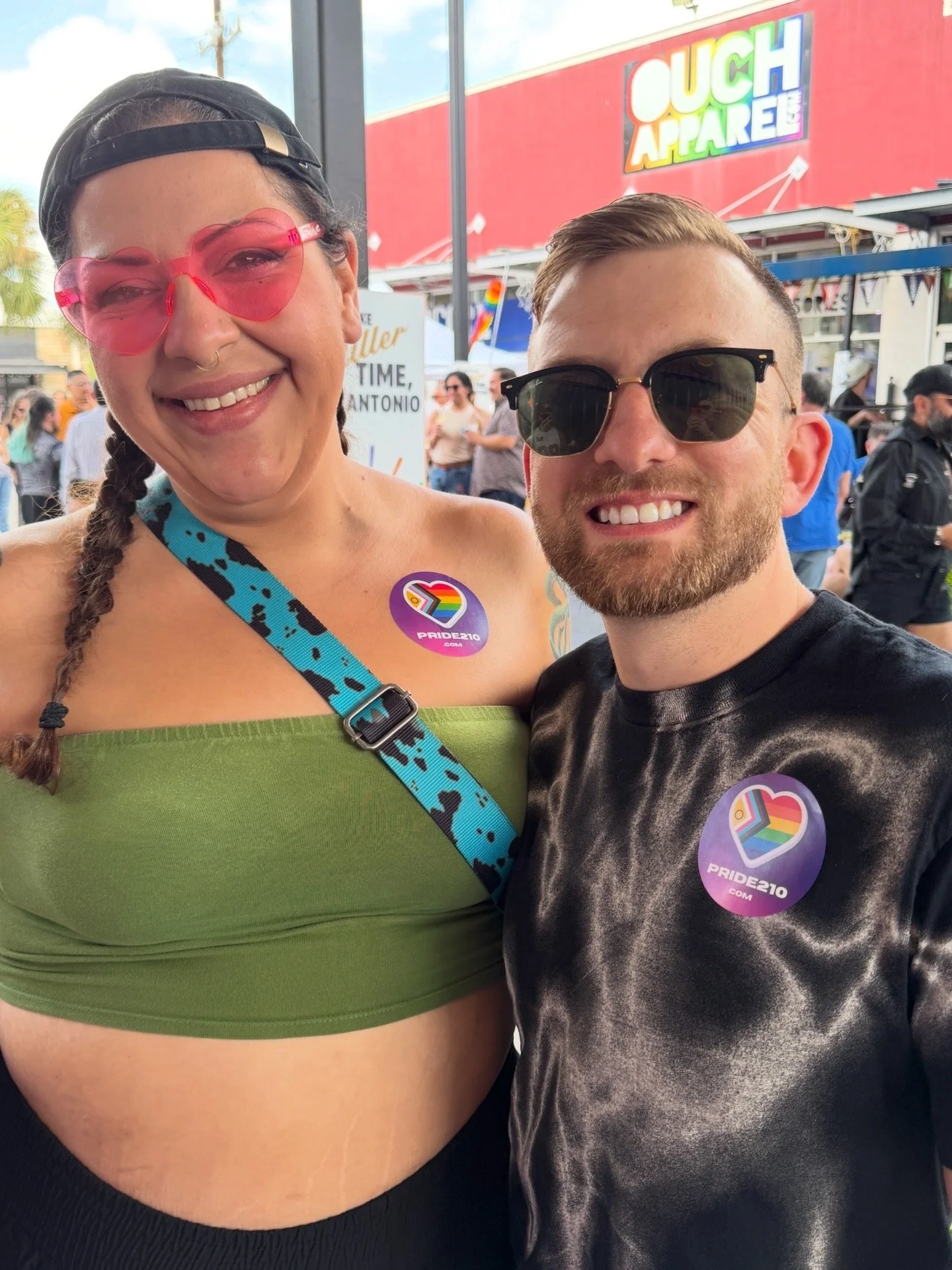
What Pride210 is working towards
-
Pride210 is working to build Pride events shaped by the people who live here. That means uplifting local artists, performers, organizations, and voices so Pride truly reflects the diversity, culture, and spirit of San Antonio.
-
Our goal is leadership that looks like the community it serves. That includes LGBTQ+ people from different backgrounds, neighborhoods, and lived experiences so decisions are made with the community, not for it.
-
Community members told us clearly in the survey that transparency matters. Pride210 is committed to open communication, clear decision-making processes, and leadership that listens to feedback from the people Pride is meant to serve.
-
Pride should bring people together. We are building partnerships with local nonprofits, advocacy groups, small businesses, and neighborhood leaders to create Pride programming that strengthens the entire community.
-
Pride210 isn’t interested in gatekeeping or controlling Pride. Our goal is to rebuild trust by listening, involving the community in decision-making, and creating space for people to participate, volunteer, and help shape the future of Pride in San Antonio.